 Beginner
Building Rock-Solid Benchwork: The Foundation of Great Layouts
Learn to construct durable, level benchwork that will last for decades
Why Benchwork Matters More Than You Think
Benchwork—the structural framework supporting your layout—determines whether your railroad will provide decades of enjoyment or years of frustration. Good benchwork is invisible; you notice it only when it fails.
The Hidden Foundation
Walk into a model railroad club and admire the scenery, motive power, and operations. What you can't see matters just as much: sturdy legs, level surfaces, and rigid construction. This invisible foundation enables everything visible.
Signs of Poor Benchwork
Inadequate benchwork causes problems: - Track irregularities: Dips and humps as wood warps - Derailments: Track joints separate from movement - Wobbly operation: Layout shakes when trains run - Inaccessible areas: Can't reach problems for maintenance - Progressive damage: Small problems worsen over time
Signs of Good Benchwork
Quality construction provides: - Rock-solid stability: No vibration or movement - Perfect level: Track stays aligned for years - Easy access: Reach any area for cleaning and repairs - Adaptability: Can modify without starting over - Longevity: Decades of service
Investment vs. Cost
Benchwork represents a small fraction of total layout cost but affects everything else. Spending extra for quality lumber, proper joinery, and careful construction pays dividends forever.
When to Build Benchwork
Build benchwork after: - Completing your track plan - Determining operating height - Planning staging locations - Understanding scenic terrain needs
Build benchwork before: - Purchasing track - Starting any scenery - Committing to wiring plans
MODELTRAINS.AI's layout planning tools generate benchwork requirements based on your track plan, including dimensions, suggested construction methods, and material lists.
Choosing Your Benchwork Style
Two primary benchwork styles dominate model railroading: L-girder and open grid. Each has advantages depending on your layout design.
L-Girder Construction
L-girder benchwork uses an L-shaped beam (made from two boards joined at 90 degrees) as the primary structural member. Joists (cross pieces) clamp to these girders and can be adjusted.
Advantages of L-Girder:
- Extremely rigid structure - Joists adjustable for curved roadbed - Easy to modify later - Accommodates complex track arrangements - Preferred for terrain variations
L-Girder Components:
- **L-girders:** Primary beams, typically 1x4 and 1x2 joined - **Joists:** Cross pieces, 1x4 lumber - **Risers:** Vertical pieces supporting roadbed - **Legs:** Support entire structure
Open Grid Construction
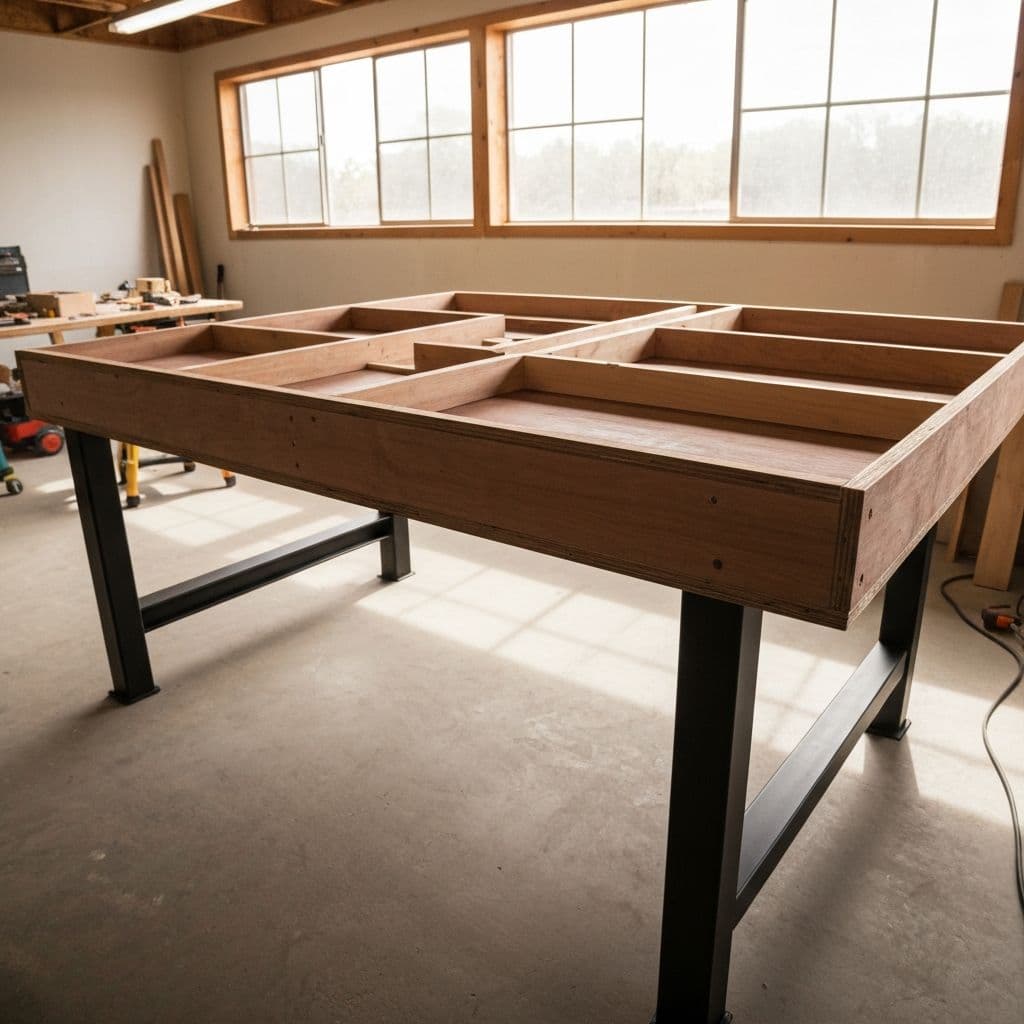
Open grid uses a grid of joists attached to a flat frame, similar to house floor construction. Simpler than L-girder but less flexible.
Advantages of Open Grid:
- Simpler construction - Good for flat or slightly varying terrain - Easier for beginners - Works well for sectional layouts - Quick to build
Open Grid Components:
- **Frame:** Perimeter boards - **Joists:** Parallel boards within frame - **Cross bracing:** Diagonal stability - **Legs:** Support structure
Which Style to Choose?
Choose L-Girder when:
- Track plan has significant elevation changes - You want flexibility for future modifications - Curved alignment requires adjustable joists - Building in place (not portable)
Choose Open Grid when:
- Layout is primarily flat - Building modular/sectional - Simplicity is priority - Following a rectangular track plan
Hybrid Approaches
Many layouts combine methods: - L-girder for mainline with terrain - Open grid for flat yard areas - Table-style for staging
MODELTRAINS.AI's benchwork recommendations match your track plan characteristics, suggesting the most appropriate construction method for each section.
Lumber Selection and Materials
Selecting proper materials prevents problems later. Lumber quality varies dramatically—understanding what to look for saves frustration.
Lumber Quality Matters
Visit any home center and you'll find stacks of lumber. Most pieces are fine for rough construction, but benchwork demands straighter, drier material.
What to Look For:
- . Straightness: Sight down each board's length. Reject curves, twists, bows.
- . Dryness: Wet lumber warps as it dries. Feel weight—heavier means wetter.
- . Grain: Straight, tight grain is stronger and more stable.
- . Defects: Avoid large knots, splits, checking.
Recommended Lumber Types:
Dimensional Pine (SPF):
- Inexpensive and widely available - Select #2 or better grade - Let acclimate to your space for a week before use
Poplar:
- More stable than pine - Costs more but machines better - Good for exposed areas
Plywood:
- Use cabinet-grade for roadbed - Avoid construction sheathing (voids cause problems) - 1/2" typical for roadbed, 3/4" for structural
Lumber Dimensions Commonly Used:
- 1x2: L-girder construction, small risers
- 1x3: Joists, risers, bracing
- 1x4: L-girders, main joists, frames
- 2x2: Legs (actually 1.5" x 1.5")
- 2x4: Heavy legs, floor runners
Non-Wood Materials:
Extruded Foam:
- Roadbed and scenery base - 1" or 2" thickness - Blue or pink—avoid white bead foam
Metal:
- Aluminum angle for leg bracing - Steel shelf brackets - More stable than wood for some applications
Fasteners:
- Screws: Preferred over nails—stronger, removable
- Carriage bolts: For adjustable joints
- Glue: Add wood glue to screw joints for maximum strength
- Joist hangers: Premade metal brackets simplify construction
Material Quantities
List materials needed before purchasing. MODELTRAINS.AI's planning tools generate material lists based on your benchwork design, minimizing waste and extra trips.
Construction Techniques and Assembly
Proper construction techniques ensure your benchwork remains solid for decades. Take time to build correctly—shortcuts cause problems later.
Tools You'll Need:
- Power drill and bits
- Circular saw or hand saw
- Carpenter's square
- 4' level
- Tape measure
- Clamps (at least 4)
- Safety glasses
Building L-Girder Benchwork Step by Step:
Step 1: Build the L-Girders 1. Select straight 1x4 boards for girder bases 2. Cut 1x2 to same length 3. Glue and screw 1x2 to 1x4 creating L-shape 4. Use clamps, check square while glue dries 5. Screws every 8-10 inches
Step 2: Install Legs 1. Determine working height (usually 40-50" for standing) 2. Cut 2x2 legs to height minus girder thickness 3. Attach legs to girders with carriage bolts (allows leveling adjustment) 4. Space legs every 4-6 feet 5. Add diagonal bracing between legs
Step 3: Attach Joists 1. Mark joist locations per your plan 2. Cut 1x4 joists to width 3. Attach with clamps (allows adjustment) 4. Or screw through girder into joist ends 5. Add additional support at turnouts and curves
Step 4: Level Everything 1. Place level on girders, adjust leg bolts 2. Check level in both directions 3. Verify joists are level 4. Take your time—this step is critical 5. Recheck after a few days as wood settles
Building Open Grid Benchwork:
Step 1: Build the Frame 1. Cut frame pieces to overall dimensions 2. Join corners with screws and glue 3. Check frame for square (measure diagonals—should be equal) 4. Add center joists at 12-16" intervals
Step 2: Add Legs 1. Attach legs at corners and along long sides 2. Bolt through frame sides into leg tops 3. Brace legs with diagonal pieces 4. Level frame before final tightening
Critical Success Factors:
- Pre-drill all screw holes: Prevents splitting
- Use glue with screws: Dramatically stronger joints
- Check square constantly: Out-of-square causes cascading problems
- Level before and after: Verify nothing moved during assembly
Roadbed, Risers, and Final Preparation
With the main structure complete, add roadbed support and prepare for track installation. This layer bridges benchwork and trackwork.
Understanding Roadbed
Roadbed serves multiple purposes: - Provides smooth surface for track - Absorbs vibration and reduces noise - Creates proper track profile - Allows grade transitions
Roadbed Options:
Foam Roadbed (Woodland Scenics, Midwest):
- Pre-shaped for correct profile - Easy to install with adhesive - Good sound deadening - Works with flex track - Best choice for most layouts
Cork Roadbed:
- Traditional approach - Splits down center, beveled edges - More work than foam but cheaper - Good results when carefully installed
Homosote (Fiber Board):
- Excellent sound deadening - Requires cutting to shape - Dusty to work with - Traditional material, less common now
Extruded Foam Sheet:
- Cut your own roadbed - Very economical - Good for grades with varying thickness - Requires more finishing work
Installing Risers for Grades
Risers lift track above the base benchwork level:
- . Calculate rise needed at each point per your plan
- . Cut risers from 1x3 or plywood strips
- . Attach to joists vertically
- . Top of risers = bottom of roadbed
- . Check elevation with string line
Creating Smooth Grades:
- . Install risers at endpoints of grade
- . Stretch string between tops to verify straight climb
- . Add intermediate risers to support roadbed
- . Risers every 12" minimum
- . More support = smoother track
Sub-Roadbed:
Many layouts use a layer between risers and roadbed: - 1/4" or 3/8" plywood - Homasote sheet - Foam sheet
This provides continuous support and simplifies roadbed installation.
Before Installing Track:
Complete these steps: 1. Verify all benchwork is level and stable 2. Confirm grades match plan calculations 3. Install all risers and sub-roadbed 4. Paint or seal any exposed wood 5. Route holes for wiring droppers 6. Clean up sawdust and debris
Testing Your Work:
Before proceeding to track: - Push on benchwork at multiple points—no movement - Set level on roadbed surface—perfect level - Walk around layout—verify access to all areas - Reach toward center—can you maintain track there?
Your benchwork is now ready for track installation. MODELTRAINS.AI's tutorials guide you through the next steps of laying track, wiring, and beginning scenery work.
Frequently Asked Questions
What is the best benchwork style for beginners?
Open grid construction is simplest for beginners with primarily flat layouts. For layouts with hills and valleys, L-girder is worth learning as it provides more flexibility. Both methods use similar materials and basic woodworking skills.
What height should model railroad benchwork be?
For standing operation, 40-50 inches is typical—about waist height. For seated operation, 30-36 inches works well. Consider your viewing preference and whether children will operate the layout. Adjustable-height legs allow fine-tuning.
What lumber should I use for benchwork?
Select #2 or better pine (SPF) for most applications. Look for straight, dry boards without twists or large knots. Let lumber acclimate to your workspace for a week before construction to prevent warping. Use 1x4 for girders and joists, 2x2 for legs.
How do I keep benchwork from sagging or warping?
Use quality dry lumber, add proper bracing between legs, space joists no more than 16 inches apart, and ensure adequate leg support (every 4-6 feet). Glue all screw joints, and allow new wood to acclimate before building. Level carefully during construction.